



Equipment Foundations
Sugar plants work under the conditions when constant production, accurate working of equipment, and safety of processes are essential.
Equipment Foundations
Civil construction and mechanical operation interfaces equipment foundations. Our structures not bear the weight of stationary objects, but also regulate vibration, provide alignment, and also help to provide stable performance of equipment during its operational life. Poorly engineered or implemented foundations may cause misalignment, undue vibration, structural distress and unwanted downtimes in the industrial setting.
The foundation work is carried out as a civil engineering undertaking by Creative Engineers that is done in cooperation with equipment properties and the geography of the location. It is aimed at providing the foundations that will sustain the stable and safe operation in the long term and avoid heavy load transfer to the ground.

Equipment Performance Role of Foundations
Compressors, pumps, blowers, crushers, conveyors and rotating machinery put both types of static and dynamic loads on the foundation. These forces are dependent on operating speed, mass and duty cycle.
Our effective foundation structures manage settlement, restrict the transmission of vibrations and keep the equipment in place. The foundation geometry, mass and reinforcement detailing are thus made to match the behaviour of the equipment at hand as opposed to the generic civil layouts.

Knowledge in Equipment Loads
Our foundation planning process starts with the examination of equipment data such as weight, centre of gravity, operating speed and the dynamic loading characteristics. In the case of rotating / reciprocating equipment, the issue of vibration gains particular significance.
Our engineers evaluate load combinations to make sure that foundations are capable of resisting operation forces without cracking, displacement, or resonance. The foundation sizing, reinforcement design and construction detailing are all based on this assessment.

Soils and Site Evaluation
We understand that the foundation performance directly depends on the ground conditions. Before execution, soil bearing capacity, settlement behaviour and ground water conditions are evaluated.
The choice of foundation type and depth makes sure that there is a stable load transfer to the ground. Where variable soil conditions occur, foundation solutions are modified to ensure that the performance is consistent and avoid differential settlement that may occur and affect equipment alignment.
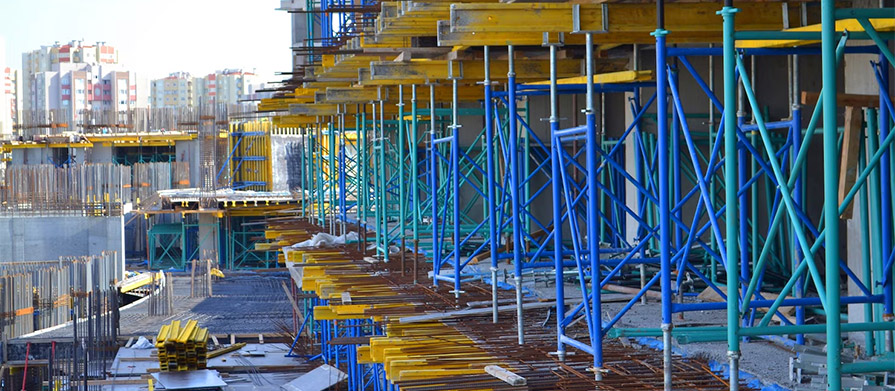
Types of Foundation and Configuration
The equipment foundations come in varied types like isolated footings, block foundations, combined foundations, or pedestal-supported systems depending on the size of equipment and loading.
Based on equipment set up, load distribution, and available space, configuration is established. This is aimed at ensuring that it is strong enough and firm enough to contain vibration but is easy to construct and easy to install and maintain.

Reinforcement and Structural Detailing
Pockets and sleeves are pre-drilled, and embedded plates are placed correctly to provide the fixation of equipment. There is a lot of control in tolerances such that it does not lead to alignment problems during installation.

Accuracy and Level Control of Construction.
We believe that the accuracy of construction is very important in equipment foundations. The dimensions, heights and the positions of bolts should be as accurate as possible with regard to equipment installation.
Control of the level is observed when concreting to allow flat and true bearing surfaces. Any deviation during this stage would lead to operation difficulty in alignment, high vibration, or early wear after commissioning of the equipment.

Co-ordination with Equipment Installation
Structural foundation work is closely interlinked with the mechanical installation activities. Setting of anchor bolts, grouting provisions and equipment base interfaces are to be pre-planned.
This coordination helps such that equipment can be installed without re-work or site alteration. The surface of grouting is done in the right way to allow the transfer of loads between baseplates and foundations of equipment.

Construction in Operational Plants
The foundation work of equipment is also carried out in the existing plants where there are space limitations and safety factors are of great concern. Execution in such scenarios takes into consideration limited access, close working equipment and plant safety measures.
Our work sequencing is planned to reduce interference but provide a safe construction and curing of the foundations before the machinery is set up.

Quality Checking and Inspection
Control measures on quality involve checking of excavation levels, positioning of reinforcements and placement of anchor bolts and quality of concrete. The measurement of concrete strength and curing is conducted to make sure that the foundation is able to perform the design.
Our engineers conduct dimensional checks before structuring foundations on equipment erection. Records on documentation are kept at the necessary places to guarantee quality and client record.

Long-Term Stability and Vibration Control
Well designed foundations minimize the vibration to the structures around them and ensure that amplification does not occur during operation. This helps to ensure the easier working of equipment and lowers the strain on mechanical parts.
Stability in the long-run is attained through proper design, proper execution, and proper selection of materials. The foundations should be reliable and last long without much maintenance during the life of the equipment.
Industrial Applications
Within steel, cement, power, construction, and process infrastructure industries, there is a need for equipment foundations. It is used in foundations of heavy machinery, material handling equipment, utilities as well as auxiliary systems.
All industries come with their own loading and environmental conditions and the foundation solutions should be designed according to the real operation requirements.
Frequently Asked Questions
What is the difference between equipment foundations and normal building foundations?
The design and implementation of equipment foundations should be more specialised to ensure that vibration is controlled as well as that alignment is maintained rather than only bearing a load.
What are the vibration considerations in the foundation design?
Vibration control is done regarding mass, stiffness, geometry, and reinforcement of foundations as per the nature of the equipment.
Is it possible to build foundations within plants that are operational?
Yes. The foundation work is usually done in controlled sequence operating plants and with important safety procedures.
What is the significance of the accuracy of the anchor bolts?
The positioning of anchor bolts is very important. Poor positioning can cause a problem with alignment and delays in installation.
What are the times in which equipment can be installed once foundation casting is finished?
Installation of equipment is usually done after the foundation has reached necessary strength as stipulated by curing and quality verification.

Your Trusted Partner in Industrial Fabrication.
Lorem ipsum dolor sit amet, consectetur adipiscing elit. Sed do eiusmod tempor incididunt ut labore et dolore magna aliqua. Ut enim ad minim veniam, quis nostrud exercitation ullamco laboris nisi ut.